
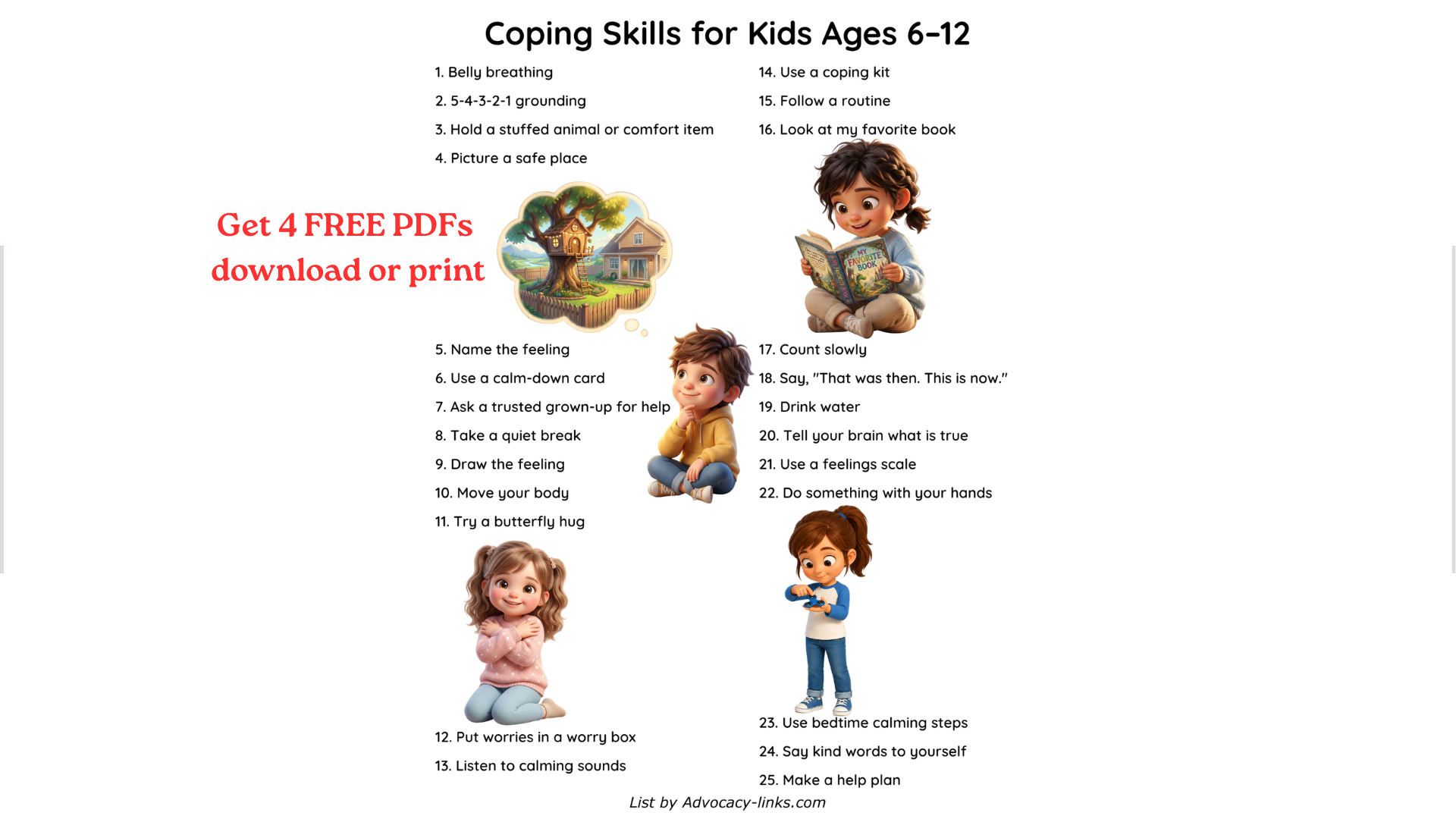
Children ages 6 to 12 with PTSD may have big feelings, scary memories, worries, or moments when their body feels upset or unsafe. Coping skills can help them calm their body, feel more in control, and remember that they are safe right now. These skills are simple things a child can practice at home, at school, or with a trusted grown-up when they feel scared, sad, angry, worried, or overwhelmed. Four free printable PDFs are also included: coping skills list for parent, child list with color images, child list with black/white images and child list without images.
Coping Skills for Kids age 6 – 12 with PTSD
- Belly breathing
Put one hand on your belly. Breathe in slowly like you are smelling a flower. Breathe out slowly like you are blowing bubbles. - 5-4-3-2-1 grounding
Name 5 things you see, 4 things you feel, 3 things you hear, 2 things you smell, and 1 thing you taste. This helps your brain remember, “I am here right now.” Grounding can help when someone feels overwhelmed by memories or strong emotions. - Hold something comforting
Hold a stuffed animal, blanket, smooth rock, bracelet, or fidget toy. Notice how it feels in your hand. - Safe place picture
Close your eyes and imagine a safe place. It could be your bedroom, a beach, grandma’s house, a treehouse, or anywhere that feels calm. - Name the feeling
Say: “I feel scared,” “I feel mad,” “I feel sad,” or “I feel worried.” Naming the feeling can help kids feel more in control. - Use a calm-down card
A child can keep a small card that says:
“I am safe right now.”
“This feeling will pass.”
“I can ask for help.”
“My body is having a big feeling, but I am okay.” - Ask for a trusted grown-up
The child can say, “I need help,” “Can you sit with me?” or “Can we take a break?” - Take a quiet break
Go to a calm spot, reading corner, bedroom, counselor’s office, or quiet area. This is not punishment. It is a reset. - Draw the feeling
Draw what the feeling looks like. It can be a storm cloud, monster, scribble, volcano, or heavy backpack. The picture does not have to be pretty. - Move the body
Try walking, stretching, jumping jacks, dancing, wall push-ups, or squeezing a stress ball. Movement can help the body let out nervous energy. - Butterfly hug
Cross arms over the chest and gently tap each shoulder, left-right-left-right. Go slow and breathe. - Use a worry box
Write or draw the worry on paper. Put it in a box or jar. The child can “save it” to talk about later with a trusted person. - Listen to calming sounds
Try soft music, rain sounds, ocean waves, white noise, or a favorite calm song. - Make a coping kit
A small box or bag can include a fidget, gum or mints, coloring pages, crayons, a stuffed animal, a family photo, headphones, and a calm-down card. - Use a routine
PTSD can make kids feel like things are unsafe or unpredictable. A simple routine for morning, after school, and bedtime can help the child know what comes next. Trauma-informed care focuses on safety, support, and avoiding things that make the child feel unsafe again. - Read or look my favorite book
A familiar book can help the child’s brain shift from fear to comfort. - Count slowly
Count to 10, 20, or 50. Or count objects in the room, like tiles, books, lights, or colors. - Use “now and then” words
Say: “That was then. This is now.”
“I am in my room.”
“I am at school.”
“I am safe with my teacher.” - Drink water or have a small snack
Sometimes the body needs a simple reset. A drink of water, crunchy snack, or warm drink can help some kids feel grounded. - Tell the brain what is true
Try:
“I am not in danger right now.”
“My body is remembering something scary.”
“I can breathe.”
“I can get help.” - Use a feelings scale
Ask: “Is my feeling a 1, 5, or 10?”
If it is a 1–3, the child might use breathing.
If it is a 4–7, the child may need a break.
If it is an 8–10, the child may need a trusted grown-up right away. - Do something with the hands
Clay, Play-Doh, coloring, LEGOs, puzzles, beads, or tearing scrap paper can help the body calm down. - Practice bedtime calming
Try the same bedtime steps each night: bathroom, pajamas, story, breathing, night-light, comfort item. Nighttime can be harder for kids with PTSD, so a steady routine can help. - Use positive self-talk
Child Mind Institute lists positive self-talk, mindfulness, exercise, and deep breathing as healthy coping skills for children.
Examples:
“I can get through this.”
“I am brave even when I feel scared.”
“Feelings are not forever.” - Make a help plan
The child should know:
“Who can I go to?”
“Where is my safe place?”
“What words can I use?”
“What helps my body calm down?”
Coping Skills for Kids Ages 6–12
- Belly breathing
- 5-4-3-2-1 grounding
- Hold a stuffed animal or comfort item
- Picture a safe place
- Name the feeling
- Use a calm-down card
- Ask a trusted grown-up for help
- Take a quiet break
- Draw the feeling
- Move your body
- Try a butterfly hug
- Put worries in a worry box
- Listen to calming sounds
- Use a coping kit
- Follow a routine
- Look at my favorite book
- Count slowly
- Say, “That was then. This is now.”
- Drink water
- Tell your brain what is true
- Use a feelings scale
- Do something with your hands
- Use bedtime calming steps
- Say kind words to yourself
- Make a help plan
Tiny Version for Kids
- Breathe
- Look around
- Hold something safe
Four free printable PDFs are also included: